Populations and Generalizability
Chapter 8
Example 2

You want to evaluate the effectiveness of the Pfizer vaccine on COVID. You ask for 1,000 volunteers and randomly give half of the volunteers the vaccine and the other half a placebo dose. These people get tested for COVID every week for a year and we record who tests positive for COVID during this time and their symptoms.
What type of conclusions can we draw?
- causal conclusions generalized to the whole population
- causal conclusions only applicable to the sample
- no causal conclusions (correlation only) generalized to the whole population
- no causal conclusions (correlation only) only applicable to the sample
Types of random sampling
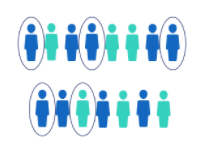
- Simple Random: observations are selected randomly from the population, each having an equal chance of being selected.
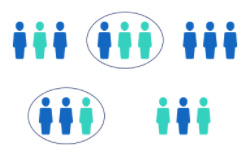
- Cluster Sampling: first the population is divided into sub-groups, and then x sub-groups out of all groups are randomly selected.
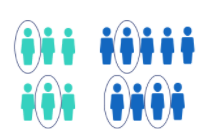
- Stratified Sampling: first the population is divided into sub-groups, and then within each sub-group x observations are randomly selected.
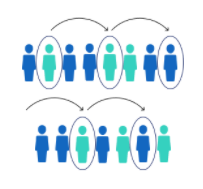
- Systematic Sampling: select some starting point, then every \(k^{th}\) observation of the population is selected.
Example 3
Northwestern University is deciding which undergraduate students to test for COVID this week and due to limited resources they cannot test the entire undergraduate student body at once.
- Population of interest: undergraduate students at NU
The university divides the population into 4 groups {1st year, sophomore, junior, seniors} and randomly selects 200 students from each group to test.
What type of sampling is this?
- simple random
- cluster sampling
- stratified sampling
- systematic sampling
- none of the above
The university alphabetizes the population by last name and selects every \(25^{th}\) student to get tested.
What type of sampling is this?
- simple random
- cluster sampling
- stratified sampling
- systematic sampling
- none of the above
The university alphabetizes the population by last name and selects the first 200 students to get tested.
What type of sampling is this?
- simple random
- cluster sampling
- stratified sampling
- systematic sampling
- none of the above